
Baixe as partidas em PGN.
Este é a primeira postagem da coluna “O Teste do Tempo”, que se propõe quotidiana no site da ALEX.
Todo mundo possui partidas que deveria comentar e expor aos amigos. Botvinnik, o pai do estudo científico do jogo do Xadrez chamava isso de “expor-se ao teste do tempo”, o que levou Kasparov a escrever um livro de suas próprias partidas que se chamava exatamente “O Teste do Tempo”.
Além disso, partidas antigas são uma excelente oportunidade para se relembrar os detalhes humanos das grandes batalhas enxadrísticas que se travaram ao longo do tempo. Assim, todos estão convidados a publicarem suas partidas analisadas e comentadas, bem como seus relatos de torneios, campeonatos e matches.
Para iniciar, apresentamos quatro partidas, três entre sócios do Clube e uma enviada por um sócio, que a achou muito interessante.
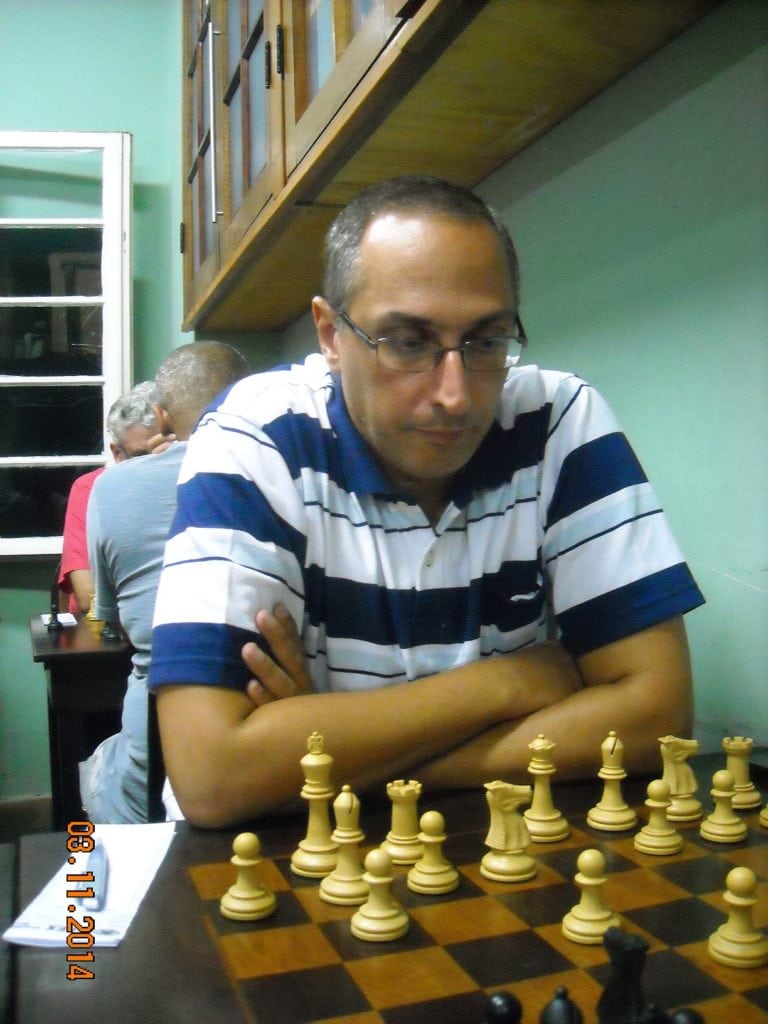
“Candidate Master” Raimondo Bottari – ALEX – Federação Italiana de Xadrez – Rating 2138
Os comentários da primeira partida são do alexano e “Candidate Master” Raimondo Bottari.
[pgn height=650 layout=horizontal showMoves=figurine initialGame=1 initialHalfmove=start autoplayMode=none]
[Event “Torneio Interno de Verão ALEX”]
[Site “Rio de Janeiro”]
[Date “2014.03.18”]
[Round “2.1”]
[White “Padua, Antonio”]
[Black “Bottari, Raimondo”]
[Result “0-1”]
[WhiteElo “1919”]
[BlackElo “2165”]
[EventDate “2014.??.??”]
[EventCountry “BRA”]
{Venci o Classe “A” Antonio Pádua que vem disputando vários torneios ultimamente com bons resultados.} 1. c4 g6 2. g3 Bg7 3. Bg2 Nf6 4. Nc3 O-O 5. d3 d6 6. e4 c5 {Entramos numa Inglesa variante Botvinnik e implementei o plano habitual para aproveitar o “hole” em d4 } 7. Nge2 Nc6 8. O-O Bd7 9. f3 Ne8 10. Be3 Nc7 11. Qd2 Ne6 12. Rab1 Qa5 13. a3 Ned4 14. Bf2 a6 15. Rfd1 Rfb8 16. Nxd4 Nxd4 17. Nd5 Qd8 18. b4 cxb4 19. Rxb4 b5 20. Kh1 e6 21. cxb5 Nxb5 {Meu adversário cometeu um erro quando jogou} 22. Nb6 $2 {porém acabei jogando} Bc3 $6 {antecipadamente e, ao invés de peça a mais, fiquei com qualidade a mais, com posição igualmente superior devido as peças brancas estarem bastante passivas. } ({O branco perderia de imediato com o lógico} 22… Rxb6 $1 23. Bxb6 Qxb6 24. a4 Bc3 25. Qxc3 (25. Rxb5 Qd4) 25… Nxc3 26. Rxb6 Nxd1 {e o negro ganha}) {A partida continuou assim:} 23. Qe3 Bxb4 24. axb4 Ra7 25. Nxd7 Rxd7 26. f4 Rc7 27. h4 Rc2 28. Qf3 Rbc8 29. Be3 Qf6 30. h5 Rb2 31. h6 Rcc2 32. e5 Qd8 33. Bf1 dxe5 34. Bb6 $4 Rh2+ { e mate no próximo lance. 0-1} 0-1
[Event “Torneio Interno da Primavera ALEX”]
[Site “Rio de Janeiro”]
[Date “2013.11.21”]
[Round “2.1”]
[White “Diaz, Marcos”]
[Black “Frota, Alvaro”]
[Result “0-1”]
[ECO “E92”]
[WhiteElo “1719”]
[BlackElo “2035”]
[PlyCount “70”]
[EventDate “2013..”]
[EventRounds “5”]
[EventCountry “BRA”]
1. d4 Nf6 2. c4 g6 3. Nc3 Bg7 4. e4 d6 5. Nf3 O-O 6. Be2 e5 7. d5 a5 8. Bg5 h6 9. Bh4 Na6 10. a3 g5 11. Bg3 Nc5 12. Qc2 a4 13. Rd1 Nh5 14. Nd2 Nf4 15. Kf1 f5 16. h4 Nxe2 17. Kxe2 f4 18. Bh2 g4 19. Bg1 f3+ 20. gxf3 gxf3+ 21. Ke1 Rf4 22. Nf1 Rxh4 23. Bh2 Qg5 24. Rg1 Rg4 25. Bg3 h5 26. Ne3 h4 27. Nxg4 hxg3 28. Rxg3 Bxg4 29. Rb1 Qh4 30. Qd1 Nb3 31. Rg1 Qh2 32. Rf1 Bh3 33. Qd3 Qg2 34. c5 Qxf1+ 35. Qxf1 Bxf1 {Sem comentários! 0-1} 0-1
[Event “World Championship Match “]
[Site “Madras”]
[Date “2013..”]
[Round “?”]
[White “Viswanathan Anand”]
[Black “Magnus Carlsen”]
[Result “0-1”]
[ECO “E25”]
[Annotator “chessbibliophile”]
[PlyCount “56”]
[EventDate “2013..”]
1. d4 {“No Berlin this time, and the entire world claps” commented Joshua Friedel on the ChessBase News Page.} Nf6 2. c4 e6 3. Nc3 Bb4 {The Nimzo-Indian Defence.} 4. f3 {This sharp variation used to be a favorite of Alexei Shirov. White aims for a broad pawn centre with e4. Its drawback is the delay in normal development with moves like Nf3, Bd3 and 0-0.} ({We reach the same position through the Saemisch Variation} 4. a3 Bxc3+ 5. bxc3 c5 6. f3 d5) 4…d5 (4… O-O {, the other line reserves more options.}) 5. a3 Bxc3+ 6. bxc3 c5 7. cxd5 exd5 ({Anand had won a poweriful game against Wang Hao’s} 7… Nxd5 {in Wijk-aan-Zee 2011. So Carlsen tries a different line.}) 8. e3 c4 $6 {A committal move preventing normal development with Bd3 followed by Ne2.But it releases the pressure on d4 and now White can play for e4 advance and build a powerful pawn centre. The well-known classic, Botvinnik-Capablanca, AVRO 1938 showed the flaw in this kind of strategy by Black.} (8… O-O {is OK.}) ({In ChessPublishing.com John Emms recommends} 8… Qc7 {with some wonderful lines. But I suspect, White may be better, going by his own analysis.} 9. Bd3 (9. Ra2 cxd4 10. cxd4 Bf5 11. g4 Bg6 12. h4 $5 $13) 9… cxd4 {In a sense a logical follow-up of the previous move.Black piles up pressure on c3.} ({Nevertheless, } 9… Nc6 {still deserves attention.}) 10. cxd4 (10. Bb5+ Nc6 11. cxd4 $4 Qa5+ $19) 10… Qc3+ 11. Qd2 (11. Bd2 $4 Qxd3 $19) 11… Qxa1 12. Ne2 O-O 13. O-O b6 14. Bb2 Qxf1+ 15. Kxf1 Ba6 16. e4 $16 {Analysis by Emms. White occupies the centre and his pieces are well-placed. In such a position the queen is better than the two rooks.}) 9. Ne2 Nc6 ({Arkadij Naidisch wonders if} 9… h5 $5 { could make more sense here. It stops g4 advance for a while.But after} 10. Qc2 {and Nf4 White is ready for the advance, e4.}) 10. g4 {Not allowing …Bf5 and preparing Bg2, Ng3 and e4.} O-O {Castling into it.} 11. Bg2 Na5 12. O-O Nb3 13. Ra2 ({Here Anish Giri prefers} 13. Rb1) 13… b5 14. Ng3 a5 15. g5 Ne8 16. e4 Nxc1 {“Magnus didn’t want to allow Be3 and the knight on b3 might find itself to be a spectator” -Joshua Friedel on ChessBase} 17. Qxc1 Ra6 18. e5 ({Commentators suggested the prophylactic move} 18. Rb2 $1 {first,discouraging Black’s pawn advance with…b4. As Kasparov put it, “Slowing Black down on the queenside before continuing the kingside pawn advance was a strong idea.” After } Rb6 19. e5 {White can advance with f4-f5 without hindrance.}) 18… Nc7 ({In the press conference after the game Carlsen said, he would have liked to block the pawns with} 18… g6 {followed by…Ne8 and…Ng7. But after} 19. f4 Ng7 20. Rb2 Rb6 21. Qb1 {“he (Vishy) could attack the pawns and that was a bit inconvenient for me. So I had to go for counterplay.” Anish Giri, however, believes, Black would have held the position with} Qd7) 19. f4 ({Joshua Friedel’s suggestion,} 19. Rb2 $5 {still deserves attention.}) 19… b4 20. axb4 {This move was widely criticised. But it has its logic. Black rook was guarding the third rank and ready to come to the aid of the king. Anand must have thought, with this move he could get rid of the rook and also force the knight to go far away from his king. Yet other moves may be better.} ({Hikaru Nakamura proposed} 20. a4 $5 b3 21. Raf2 {Now Black cannot win the a-pawn with} Bd7 22. Qa3 Qe8 {on account of} 23. Qc5) ({Gelfand’s suggestion} 20. f5 {should be met by} bxc3 {according to Ian Rogers. After} ({Apparently Boris considered only} 20… Nb5 21. axb4 axb4 22. Rxa6 Bxa6 {After} 23. f6 g6 24.Qf4 {Even here Black is not without resources similar to the game.}) 21. f6 g6 22. Qxc3 {Black can take countermeasures.}) 20… axb4 21. Rxa6 Nxa6 22. f5 {A majestic advance of pawns that many thought was decisive.} ({After} 22. cxb4 {Black has a different passed pawn on the c-file and White’s d-pawn becomes a target.} Nxb4 23. f5 Qb6 24. Qc3 Nc6 {A variation given by Vishy himself.}) 22… b3 23. Qf4 ({Joshua Friedel mentions} 23. h4 Nc7 24. h5 {Although White pawns look menacing, he sees no clear way of breakthrough. However, Anish Giri stil thinks it’s a promising line.} ({Kasparov suggested} 24. Qa3 {here. But after} Nb5 {White has to worry both about the defence of c3 and also Black’s pawn advance, …b2.})) ({Instead the Naiditsch suggestion} 23. Nh5 Nc7 24. Qe3 {is strong. White targets the d5 pawn and also attacks on the kingside.}) 23…Nc7 24. f6 $2 {A move criticised as “premature” by commentators.} ({Kasparov and others recommended} 24. Qh4 $1 {If} Ne8 25. Nh5 b2 26. f6 g6 27. Nf4 $1) 24… g6 25. Qh4 Ne8 26. Qh6 (26. Ne2 $5 {deserves attention. “It keeps possibilities open, gives Black more chances to err unde rpressure” -Kasparov}) 26… b2 {Now Black is threatening both…Qb6 and …Qa5.} 27. Rf4 ({Anand: “If I play} 27. Rb1 {he has} Qa5 $1 {“}) ({Kasparov mentions} 27. Ne2 $5 Qa5 28. Nf4 Be6 29. Nxe6 fxe6 30. Bh3 {and adds, Black looks OK.}) 27… b1=Q+ 28. Nf1 {??!! A terrible blunder reminiscent of Tal. Wonderful fantasy with a fatal flaw. Vishy thought of this move only after he did not see a win after 28.Bf1.} (28. Bf1 Qd1 29. Rh4 Qh5 30. Nxh5 gxh5 31. Rxh5 Bf5 32. g6 (32. Bh3 Bg6 33. e6 Nxf6 $1 34. gxf6 Qxf6) 32… Bxg6 33. Rg5 Nxf6 (33… Qa5 34. h4 Qxc3 35. Rg4) 34. exf6 Qxf6 35. Rxd5 {with a probable draw-Emms}) 28… Qe1 { “As soon as I made the knight move I saw what I had done”. And a desparing Vishy resigned on the spot. As Kasparov pointed out, Black queen and bishop never moved.} ({Vishy had calculated} 28… Qd1 29. Rh4 Qh5 30. Rxh5 gxh5 31. Ne3 $1 {Threatening Nxd5-Ne7+} Be6 32. Bxd5 Bxd5 $2 ({If} 32… Qd7 $2 33. Be4 $1 $18) ({Vishy mentioned} 32… Qxd5 $1 {for longer resistance. After} 33. Nxd5 Bxd5 {White can play h4, Qxh5 and continue with h5 and g6 winning. Or he can underscore Black’s helplessness by marching the king via a3 to e7 to deliver Qxf8 Mate.}) 33. Nf5 $1 {Again with the same threat of Ne7+ Kh8 and Qxf8 mate. The Black knight cannot move without allowing Qg7 mate. A brilliant idea that deseved better fate.}) {0-1} 0-1
[Event “Torneio Interno de Inverno ALEX”]
[Site “Rio de Janeiro”]
[Date “2013.08.13”]
[Round “6”]
[White “Frota, Alvaro”]
[Black “Murilo, Sergio”]
[Result “1-0”]
[ECO “B71”]
[WhiteElo “2063”]
[BlackElo “1980”]
[Annotator “AlvaroFrota”]
[PlyCount “31”]
[EventDate “2013..”]
[EventType “tourn”]
[EventRounds “5”]
[EventCountry “BRA”]
1. e4 c5 2. Nf3 d6 3. d4 cxd4 4. Nxd4 Nf6 5. Nc3 g6 6. f4 $5 {Tendo jogado a Variante do Dragão em rítimo “Blitz”, Sérgio Murilo continuou descarregando a variante “natural” contra o Ataque Levenfish…} Bg7 7. e5 dxe5 8. fxe5 Ng4 9. Bb5+ {até que “naturalmente” … } Kf8 $4 { … perdeu a dama(!) } 10. Ne6+ $3 {Alguém deveria ter tirado uma foto do Sérgio Murilo no exato momento em que o cavalo branco pousou na fatídica casa “e6″… Tendo gasto menos que 1 minuto de seu tempo, agora nosso amigo decidiu pensar e continuou jogando…} fxe6 11. Qxd8+ Kf7 12. O-O+ Nf6 13. Qc7 {Dentre os possíveis recuos da dama, este me pareceu o melhor pois mantem o ataque ao rei negro. Note-se que o branco ganhou uma dama inteira pois o cavalo sacrificado em sua captura poderá ser recuperado.} a6 14. Ne4 axb5 15. exf6 ({Durante a partida, deixei passar o mate mais rápido:} 15. Ng5+ $3 Kg8 (15… Ke8 16. Qxc8#) (15… Kf8 16. Qd8#) {pois não vi o lance sem xeque} 16. Qxe7 $1 {que resulta em mate inevitável no próximo} — 17. Qf7#) 15… Nc6 16. fxe7+ {e aqui Sérgio Murilo abandonou…} ({pois o branco joga e mata em quatro lances:} 16. fxe7+ Bf6 (16… Kg8 17. e8=R+ Bf8 18. Qf7# {Mate em 3!}) (16… Ke8 17. Nd6# {Mate em 2! }) {Mais simple e elegante é a promoção com duplo xeque} 17. e8=Q+ ({A força bruta funciona a contento:} 17. Rxf6+ Kg7 (17… Kg8 18. e8=R# {Mate em 3!}) (17… Ke8 18. Nd6# {Mate em 3!}) 18. e8=N+ (18. e8=Q+ Ne7 19. Rf7# {Mate em 4!}) 18… Kg8 19. Qg7# {Mate em 4!}) 17… Kxe8 18. Nd6+ Kf8 19. Qf7# { Mate em 4!}) {1-0} 1-0
[/pgn]
Os comentários da segunda partida são de Marcos Diaz. Para vê-la, clique nas reticências … acima do tabuleiro e escolha a partida.
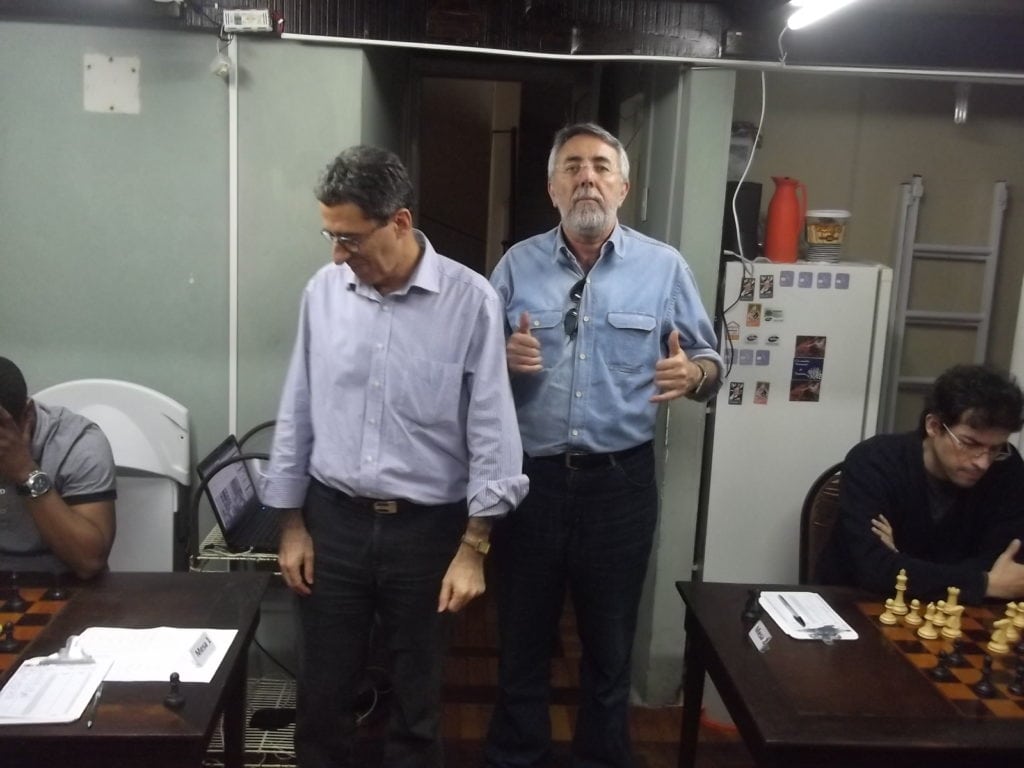
O alexano Marcos Diaz, ao lado do árbitro Antônio Elias, comemora uma vitória por WO!
A terceira partida nos foi enviada pelo associado Jéferson Menezes. A partida não é dele mas ele a achou interessante.
E a quarta e última partida doi analisada e comentada pelo capivara que escreve esta coluna.
Publique uma partida sua, analisada e comentada, bem como seu relato sobre a história do Clube! Basta enviá-los para Álvaro Frota
Além de suas partidas, comentem aqui esta postagem!
O COMENTÁRIO SOBRE A VITÓRIA DO MARCOS DIAZ!! POR WO!! FOI HILÁRIO!!! RSRSRS….KKKKKK….
Pô, Sérgio Murilo! Você só pensa maldade! Não tem nada de ruim em ganhar por WO. Ruim é levar mate!
Pô, Alvaro, só achei engraçado. rsrsrr….quanto a levar mate ” Quem dentre vós não tiver pecado, atire a primeira pedra” (Jo 8,7). rsrs… kkkkk.
Isso é verdade, Sérgio! De minha parte, cansei de levar pedradas!